
Quick Answer
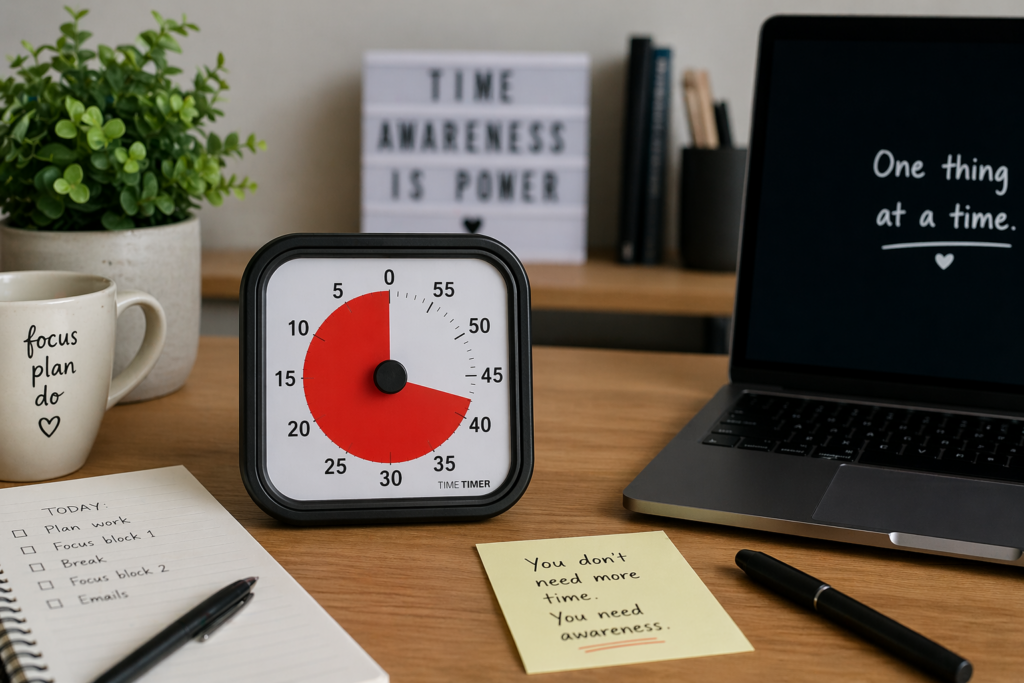
Time blindness makes it difficult to feel how much time is passing, which can lead to delays, distraction, or over-focusing. Using visual or structured timers helps make time more visible and easier to act on, supporting better focus and smoother transitions.
Introduction
Why Time Blindness Makes ADHD Focus Difficult (And How Timers Help) is a common question for people who feel like time either disappears or stretches unpredictably. You may sit down to do something simple, only to realise much more time has passed than expected, or struggle to start because the task feels undefined.
One of the most effective ways to manage this is by using external tools that make time visible and structured. For a full breakdown of options, the Best ADHD Focus Timers (UK Guide) shows how different timer types can support focus, routines, and transitions.
The issue is not a lack of effort or awareness. It is how time is processed in the moment. Without something external to anchor it, time can feel abstract, which makes it harder to prioritise, start, or stop tasks.
Why Time Blindness Makes ADHD Focus Difficult (And How Timers Help): Key Causes
Time blindness is not about ignoring time. It is about not feeling it accurately in real time, which leads to inconsistent focus and planning.
- Difficulty estimating how long tasks will take
- Weak awareness of time passing during activities
- Struggles with starting or stopping tasks at the right moment
- Tendency to hyperfocus or lose track of time completely
- Challenges with transitions between tasks or routines
Why This Happens (ADHD Context)
ADHD affects how the brain processes time, urgency, and reward. Tasks that feel distant or undefined are harder to engage with, while immediate distractions feel more compelling.
In practice, this means time is often only felt when something forces attention onto it. Without that, minutes and hours can blur together. I have found that without something visible or structured, it is very easy to assume “I’ve only been doing this for a few minutes” when it has actually been much longer.
Resources like ADDitude often highlight how time perception plays a role in ADHD routines, especially when it comes to starting tasks and managing transitions.
What Usually Goes Wrong
Most people rely on a rough sense of time or loose plans, which is usually where things start to fall apart.
You might plan to work for “a bit” but have no clear boundary, leading to distraction. Or you may delay starting because the task feels too open-ended. In other cases, hyperfocus takes over, and you miss important stopping points like breaks or other responsibilities.
Another common issue is using your phone as a timer. While convenient, it often leads to distraction because notifications, apps, and messages are all in the same place.
When you look at it this way, it becomes easier to see why time blindness makes ADHD focus difficult (and how timers help) in a practical, real-world sense rather than just as a concept.
Step-by-Step: How to Fix This
Step 1: Reduce Immediate Triggers
Start by removing obvious distractions from your environment. This could mean putting your phone out of reach or turning off notifications. The goal is to create a space where focus is easier to maintain.
Step 2: Add Effort to Distraction
If distractions are still easy to access, your brain will default to them. Adding small barriers, such as using a separate device or blocking apps, can help shift behaviour.
Step 3: Replace the Habit Loop
Instead of relying on willpower, replace unstructured time with defined focus blocks. For example, commit to 10 or 15 minutes of one task using a timer, rather than trying to “just get started.”
Step 4: Use Tools That Support Behaviour
This is where timers become useful. If you want a practical way to apply this, the guide on how to use a visual timer for ADHD focus shows how to turn this into a simple routine. Tools like the Time Timer Original or Focus To-Do App help by making time visible or structured. They reduce the need to constantly check the clock and provide a clear start and end point for tasks.
Real-World Use Cases
Time blindness affects different parts of the day, and timers can be adapted to fit each situation.
When working from home, timers can create clear work blocks, helping you avoid drifting between tasks or getting stuck on one thing for too long.
For study sessions, short timed blocks can make starting easier and reduce overwhelm. Instead of planning a long session, you focus on one manageable block at a time.
During deep work, visual timers can help maintain awareness without breaking concentration. You can see time passing without needing to check a device.
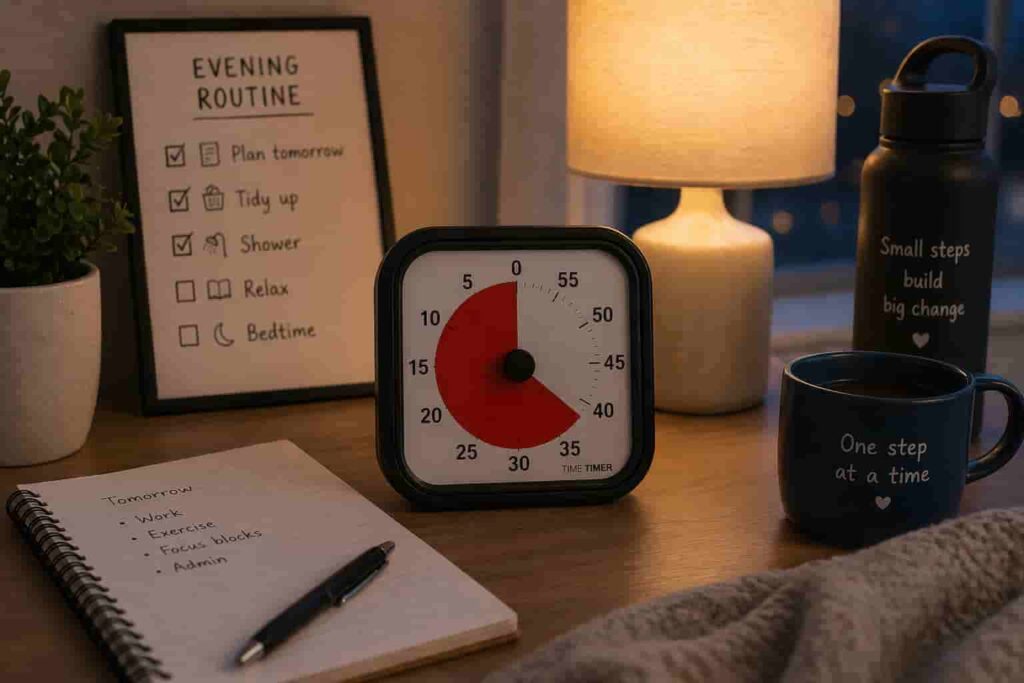
In evening routines, timers can support transitions, such as winding down, preparing for the next day, or avoiding losing time to low-value activities.
Tools That May Help
Different tools work for different preferences, but the key is choosing something you will actually use consistently.
The Secura 60-Minute Visual Timer is useful if you prefer a clear visual countdown that shows time passing.
The Time Timer MOD offers a more compact version of the same concept, making it easier to keep on your desk or move around.
App-based options can also work if used carefully, but they require more discipline to avoid distraction.
Friction Points to Expect
- Forgetting to set the timer consistently
- Ignoring the timer when deeply focused
- Choosing tools that are too complex to use regularly
- Relying on motivation instead of building a routine
Practical Reality Check
Timers are not a complete solution. They are a support tool that works best when combined with simple routines and realistic expectations.
If you expect a timer to completely fix focus issues, it will likely feel disappointing. However, if you use it to create small, manageable blocks of time, it can make a noticeable difference.
The most important factor is consistency. Even a simple 10-minute timer used regularly can be more effective than a complex system that is rarely used.
Choosing the Right Support Strategy
Why Time Blindness Makes ADHD Focus Difficult (And How Timers Help) ultimately comes down to combining the right strategies.
Start by reducing obvious distractions so it’s easier to stay focused. Then build simple habits that add structure where it was missing before. Tools like timers can help by making time easier to see and act on. If you are comparing different approaches, this breakdown of Pomodoro timer vs visual timer can help you decide which method fits your focus style. Most importantly, these changes need to fit naturally into your daily routine so they actually stick.
For example, using timers alongside a simple setup for tasks and planning can be very effective. If you are looking at broader ways to organise things, tools like digital planners are often covered in guides such as Best Digital Tablets for ADHD Productivity (UK Guide), and can work well alongside timer-based routines.
Frequently Asked Questions
What is time blindness in ADHD?
It is the difficulty in accurately sensing how much time has passed or how long tasks will take.
Do timers really help with ADHD focus?
They can help by making time visible and providing structure, especially for starting and stopping tasks.
Are visual timers better than digital timers?
For many people, yes. Visual timers make time easier to understand at a glance without needing to interpret numbers.
How long should focus sessions be?
Short sessions, such as 10–30 minutes, are often more effective because they feel manageable and reduce overwhelm.
Final Thoughts
Why Time Blindness Makes ADHD Focus Difficult (And How Timers Help) is less about fixing time itself and more about making it visible and manageable. When time becomes something you can see and respond to, it is easier to start tasks, stay engaged, and transition when needed.
Timers are not a perfect solution, but they are one of the simplest and most practical tools available. When used consistently, they can help create structure where it is often missing, making daily routines feel more predictable and easier to manage.
Build a Simple ADHD Productivity System
If you want to bring everything together into one clear setup, this guide shows how tools, apps, and routines can work as one system.