
Quick Answer
Tiny daily habits can work better than big goals with ADHD because they are usually easier to start and easier to come back to. A small action is less likely to feel overwhelming when the bigger goal has already started to feel vague, demanding or too far away.
Introduction
The appeal of tiny daily habits becomes clearer when you look at what often happens after an ambitious plan is made. On Sunday evening, the goal might be to exercise five times, clear every outstanding task, prepare healthy meals and finally organise the spare room. By Tuesday, the plan has collided with a difficult workday, low energy and three forgotten errands, so the whole thing starts to feel like another failure rather than something
The problem is not necessarily a lack of ambition. Bigger goals often ask you to stay motivated, judge time accurately and get going again quickly after something interrupts you. All of that can become much harder during a busy or emotionally demanding week. A broader setup built around realistic routines, useful tools and things that help you remember what comes next can make a real difference, as explained in the ADHD Productivity Tools UK Guide.
Tiny habits work differently because they lower the bar for getting started. Instead of expecting the full version of a routine every time, the focus stays on one small thing you can still manage. That might mean opening the document, putting one item away, taking medication beside breakfast or walking for five minutes. It may not look impressive from the outside, but it can make coming back the next day much easier.
Why Tiny Habits Are Easier to Sustain with ADHD
Small habits can feel easier because there is simply less to get through before you can begin..
- Large goals often feel distant, vague or emotionally heavy.
- Tiny actions require less motivation at the moment of starting.
- Short habits are easier to repeat on low-energy days.
- Visible completion provides a quicker sense of progress.
- A small routine is easier to restart after disruption.
- Repetition gradually reduces the number of decisions involved.
Why This Happens (ADHD Context)
Many plans fail at the starting point rather than during the task itself. You might genuinely want to tidy the kitchen, but the phrase “tidy the kitchen” contains several hidden decisions: where to begin, what counts as finished, whether the dishwasher needs emptying first and what to do with the pile that has no obvious home. Before anything has moved, the task has already expanded.
A tiny habit can remove a lot of that mental back-and-forth. “Put away three items” gives you something obvious to do, while “sort out the whole kitchen” can quickly turn into planning where to start, how long it will take and what counts as finished. Once three things are away, you can stop there. Quite often, getting started makes carrying on easier anyway, but the smaller version is still useful even when that is all you manage.
This matters because motivation and energy can look completely different from one day to the next. A routine that only works when everything is going well can disappear as soon as work becomes stressful, sleep is poor or something else demands your attention. A smaller version still gives you something you can return to when the full version feels unrealistic.
Resources such as ADDitude discuss the everyday difficulties ADHD can create around motivation, time management and routines. Tiny habits do not remove those difficulties, but they can reduce how much organising and decision-making has to happen before you actually get started.
What Usually Goes Wrong
A big goal can sound meaningful while still giving you nowhere obvious to begin. “Get fitter” is a good example: it says where you want to end up, but not what you are supposed to do right now. “Go for a walk after lunch” is much smaller, but at least you know exactly what starting looks like.
Another problem is letting a good day decide what the routine is supposed to look like every day. After a productive weekend, thirty minutes may feel completely manageable. By Wednesday evening, the same thirty minutes can feel like a major commitment, so the routine gets skipped altogether. After a few missed days, coming back can start to feel uncomfortable because the habit now carries a sense of guilt with it.
People also try to change too many things at once. A new morning routine might include stretching, journalling, medication, water, breakfast preparation, planning and exercise. Each part may be sensible on its own, but together they create a complicated sequence that can collapse when one stage is delayed. How to Create a Morning Routine with ADHD is most useful when the morning starts with a few manageable actions rather than turning into a complete lifestyle redesign.
Tracking can become another source of pressure. Missing one day can start to feel like losing the streak, which may make the second missed day easier to justify. The tracker was supposed to feel encouraging, but it can gradually turn into a record of all the days you did not manage. Treating missed days as ordinary interruptions can make it much easier to simply pick the habit up again.
Making Tiny Habits Easier to Live With
Start With a Version That Feels Almost Too Easy
The smallest version should still feel realistic on a poor day. Reading might mean one page. Cleaning might mean clearing one surface. Planning might mean writing down the one thing that matters most tomorrow. It doesn’t need to prove anything about how productive you are; it just needs to be small enough that beginning doesn’t feel like a major event.
It can also help to keep that small version genuinely small. If the habit is opening a document and writing one sentence, you do not have to turn it into a full writing session every time. Letting the one-sentence version remain useful stops the habit quietly growing back into another task you begin avoiding.
When the Useful Thing Is Easier to Notice
Small habits are much easier to remember when whatever you need is already in front of you. A notebook beside the kettle is more likely to be noticed than one hidden in a drawer, and a document already open on the computer gives you less to do before you can begin.
Distractions do not always need a complicated blocking system either. Having your phone in another room for five minutes or closing a few unnecessary tabs may be enough to stop something else getting there first. You don’t need a perfect setup; sometimes one small change gives the habit a better chance of happening.
When the Habit Fits Beside Something You Already Do
It can be much easier to remember a new habit when it follows something that already happens regularly. After brushing your teeth, you might take medication as directed. After switching on the computer, you might write the first task on a sticky note. After dinner, you might put away five things before sitting down.
This is the practical idea behind Habit Stacking for ADHD. It tends to feel easiest when the two things are simple and happen close together. If the new habit means finding equipment, changing clothes or going somewhere else first, there are simply more chances for something else to take over before you get there.
When a Tool Actually Helps
A checklist, recurring reminder or visible timer may be enough when the small habit is easy to forget. The better sign is whether you still notice the tool once the initial excitement has worn off, rather than how many features it had when you first set it up.
Habit apps can also help when ticking something off gives you a useful sense of progress. The Best Habit and Routine Apps for ADHD roundup can help you compare straightforward trackers, gamified systems and routine timers. Whatever you use, the habit itself should still be clear enough that you know exactly when you have done it.
Real-World Use Cases
When working from home, a tiny habit might be opening the priority document before checking email. You do not need to finish the task immediately. The habit simply places the correct work in front of you before messages and notifications begin deciding how the morning will be spent.
For study, the smallest version might be reading one paragraph, reviewing one flashcard set or sitting at the desk for five minutes. You may carry on once you have started, but on a difficult day that small amount can still be useful on its own. Not every study session needs to look equally productive for the routine to remain worth coming back to.
Before deeper work, sometimes it is enough to make the first few minutes feel obvious. Clearing part of the desk, putting the phone away and setting a ten-minute timer can be easier than waiting until you feel completely ready. If you carry on afterwards, great; if ten minutes is all you manage that day, it has still counted.
Evening routines can work the same way. Instead of facing a long shutdown checklist, putting tomorrow’s essentials in one place or getting water ready for medication may be enough for a tired evening. How to Build an Evening Routine That Actually Sticks works best when the routine still feels manageable after a long day, not only when the evening goes perfectly.
Tools That May Help
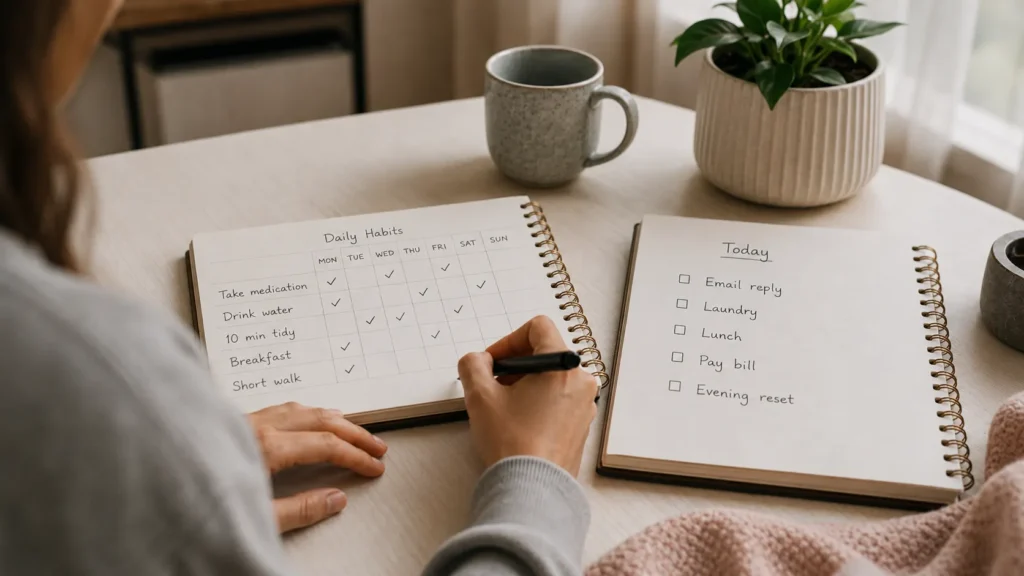
A basic habit tracker can help when days tend to blur together and you genuinely cannot remember whether you did something yesterday. Paper works well when visibility matters, while an app may suit you better when your phone is already part of the routine. The tracker is usually more useful when updating it takes only a few seconds.
Timers are useful when a habit feels open-ended. Setting a five-minute countdown gives the activity a clear boundary, which makes starting less intimidating. This is especially helpful for tidying, admin or planning tasks that otherwise seem as though they could absorb the whole evening. The Best ADHD Focus Timers (UK Guide) compares several ways to make short work periods more visible without turning them into another complicated system.
Routine apps can help when seeing one thing at a time makes the whole habit feel easier to follow. Routinery uses timed sequences, while Loop Habit Tracker keeps repeated actions much simpler. Finch takes a gentler self-care approach, whereas Habitica adds game-like rewards. Some people will get on better with structure, others with simplicity or encouragement, so there is no reason to assume the most feature-heavy option will suit you best.
Friction Points to Expect
- The habit may initially feel too small to be meaningful.
- You may increase the target too quickly after a successful week.
- Reminders can become easy to dismiss when they appear at inconvenient times.
- A missed day may create unnecessary pressure to abandon the routine.
- The thing you attached the habit to may not actually happen as regularly as you expected.
Practical Reality Check
Tiny habits are not a shortcut to instant transformation. Their value is that the useful thing stays small enough to keep coming back to. Some days five minutes may turn into half an hour, while on other days five minutes really is all you manage. Both can still be useful because the routine has not disappeared completely when life gets difficult.
Progress may also look uneven. You might do something regularly for two weeks, lose it completely during a busy period and then need to make it smaller again when you come back. That does not mean the idea failed. It simply means the version that worked during a quiet week may not fit what life looks like now.
It is also worth noticing whether the habit is still helping with the thing you originally cared about. Ticking a box can feel productive even when the action itself has stopped being useful. If something stays on the list for weeks simply because it has always been there, that may be a good sign that it no longer deserves the same attention.
Finding What Makes the Habit Easier
Making the habit smaller is only part of the picture. Even a two-minute task can disappear if it sits at the wrong point in the day or depends on you remembering it from nowhere. Something slightly longer may be much easier when it naturally fits beside something you already do.
Habits often fit more naturally around parts of the day that already have some shape to them. Starting work, meals, taking medication, brushing your teeth or getting ready for bed are usually easier to notice than a random reminder at 7:15pm. Having whatever you need nearby helps too. A notebook, charger or pair of walking shoes is much easier to use when you don’t have to go searching for it first.
The reminder also needs to be something you don’t start resenting after a week. Some people genuinely enjoy streaks and visible progress, while others begin swiping away repeated prompts almost immediately. What matters is whether the setup makes coming back feel normal rather than turning the habit into another thing you feel behind on.
Frequently Asked Questions
How small should a tiny habit be?
Small enough that you could still imagine doing it on a low-energy day. That might be one minute, one item, one sentence or one repetition.
Do tiny habits produce meaningful results?
They can, because the small action gives you something you can keep returning to. Some days it may naturally grow into more, while on other days the tiny version may be all you do.
Should I track every habit?
No. Tracking is useful only when it improves awareness or motivation. If maintaining the tracker becomes harder than performing the habit, simplify it or stop using it.
What happens if I miss several days?
Coming back with the smallest version is usually easier than trying to make up for the days you missed. One manageable action can be much more useful than planning a big catch-up session that makes restarting feel harder.
Can I build several tiny habits at once?
You can, but one or two is often easier to live with than changing several things at once. Once those first habits feel familiar and stop needing so much active remembering, adding something else may feel much less demanding.
When should I make the habit bigger?
It may make sense to do more once the current version feels easy enough to return to and the bigger version still seems realistic on an ordinary day. The tiny version can still remain there for difficult periods instead of disappearing completely.
Final Thoughts
Why Tiny Daily Habits Beat Big Goals with ADHD is really about making useful things easier to come back to. Big goals can still give you direction, but they often feel much harder at the exact moment you need to start. A tiny habit gives you something small and obvious to do even when the day has already gone off course.
The routine does not need to look impressive. Some days the tiny version may lead to much more, while on others it may genuinely be all you have the energy for. What matters is that the habit still feels simple enough to pick up again instead of becoming another abandoned plan that needs rebuilding from scratch.
Build a Simple ADHD Productivity System
If you want to bring everything together into one clear setup, this guide shows how tools, apps, and routines can work as one system.