
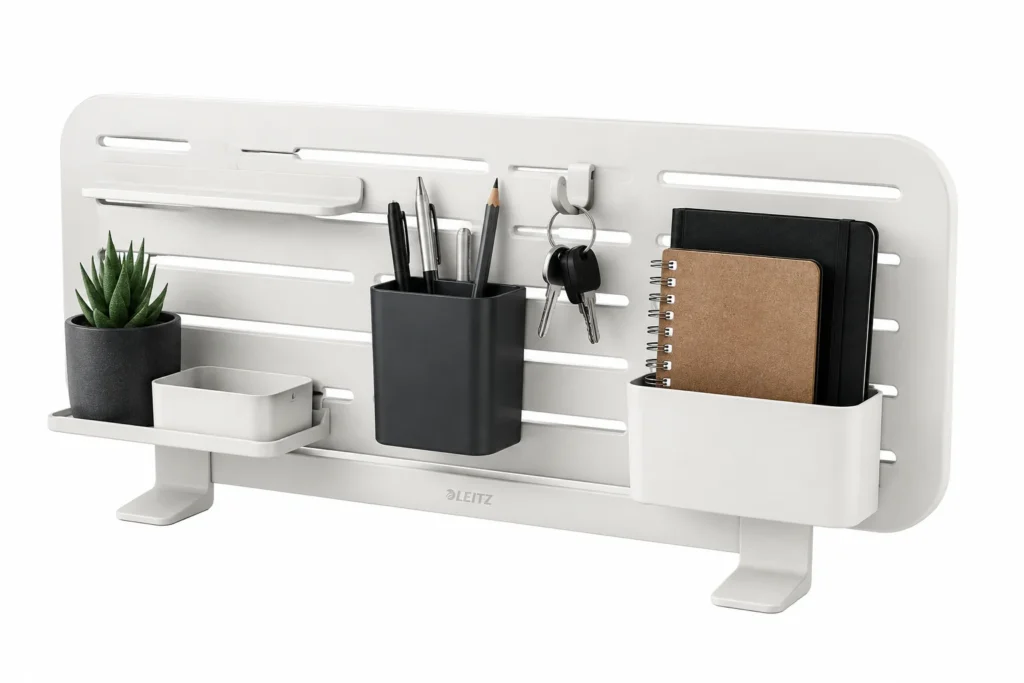
At a Glance
-
- Compact 42 × 25 cm vertical pegboard designed to move everyday items away from the main desk surface
- Includes a notepad holder, pen holder and hook suitable for headphones or similar accessories
- Accessories can be repositioned to create a layout that suits the way you work
- Clamps to a compatible desk without requiring holes to be drilled
- Useful for keeping frequently needed items visible without leaving them scattered across the desk
- Best suited to people who benefit from visible organisation rather than putting everything inside drawers
Introduction
This Leitz Ergo Pegboard Desk Organiser Review for ADHD Workspaces looks at a problem that can become surprisingly distracting: everything you need is technically on the desk, but none of it seems to have a proper home. Pens migrate underneath notebooks, headphones get left beside the keyboard, and the notepad you wanted five minutes ago somehow ends up underneath something else. The individual items are small, yet together they can make a workspace feel much busier than it needs to.
That is why desk organisation can be more useful when it is treated as part of a wider system rather than an attempt to create a perfectly tidy Instagram-style workspace. The ADHD Productivity Tools UK Guide takes the same approach more broadly, looking at ways different tools can reduce friction without giving you another complicated routine to maintain.
The Leitz Ergo Small Pegboard takes everyday desk storage upwards rather than spreading it across the working surface. The compact version is designed to clamp to a desk and includes movable storage accessories for a notepad, pens and headphones, giving frequently used items an obvious place without hiding them completely from view.
Leitz Ergo Pegboard Desk Organiser Review for ADHD Workspaces: Key Features
The main appeal is not complicated organisation. It is having a small number of useful items lifted off the desk while keeping them close enough that you do not have to remember which drawer or storage box they disappeared into.
- Compact 42 × 25 cm vertical pegboard for frequently used desk items
- Durable 8 mm MDF board with wide accessory slots
- Notepad holder included
- Pen holder included
- Hanging hook suitable for headphones or a similar accessory
- Movable accessories made from 85% post-consumer recycled plastic
- Clamp-based installation using the supplied Allen key, without drilling into the desk
- Soft rubber contact points designed to protect the desk surface
- Can be mounted above or underneath a compatible desktop up to 35 mm thick
Who This Guide Is For
This guide is particularly relevant if you like having important things visible but find that leaving everything directly on the desk eventually becomes distracting. That can create an awkward choice: put objects away and forget about them, or leave them in sight and watch the desk gradually turn into a holding area for everything you touched during the day.
The 42 × 25 cm board attaches to the edge of a compatible desk using the supplied clamp and Allen key. You don’t need to drill into the desktop or fix anything to the wall, and rubber contact points help protect the surface underneath. Leitz specifies compatibility with desktops up to 35 mm thick, although the shape of the desk edge still needs checking before purchase.
Key Takeaways
- The main benefit is moving everyday clutter vertically rather than hiding it
- Visible storage may suit people who forget items once they are put inside drawers
- The included accessories give common desk items a consistent home
- It works best when you deliberately limit what gets stored on it
- It will not fix clutter if every available slot simply becomes another place to accumulate things
How It Works
The pegboard attaches to the edge of a compatible desk using a clamp, so you can create extra storage without permanently fixing anything to the wall or drilling through the desktop. Leitz specifies compatibility with desktops up to 35 mm thick for the small model, while rubber contact points are designed to protect the desk surface.
Once it is in position, the included accessories slot into the board and can be arranged around the way you actually use your workspace. You could keep the pen holder nearest your writing hand, put the notepad where it remains visible beside the monitor and hang headphones at the edge rather than leaving them over the keyboard.
Rearranging the holders is useful while you are working out where everything feels most natural. After that, constantly redesigning the board could become another distraction. If the headphones always return to the same hook and the pen holder stays beside your writing hand, putting things away starts to require much less thought.
Why It May Help (ADHD Context)
Organisation can become difficult when two sensible strategies pull in opposite directions. Putting everything away creates a clean surface, but things that disappear from view can also disappear from mind. Leaving everything visible solves that problem, yet too many objects competing within the same visual area can make it harder to settle on the thing you were actually supposed to be doing.
Resources such as ADDitude regularly discuss practical environmental approaches to ADHD organisation and distraction. A pegboard is not an ADHD treatment, but it can support the practical idea of giving important objects clear, visible homes so that keeping track of them requires less active effort.
The useful part isn’t creating a perfectly tidy desk. It is no longer having to decide where the headphones should go, move a pen away from the keyboard or search underneath papers for the notepad. Each item has an obvious place to return to, and keeping that location consistent can make putting it away feel like the natural end of using it rather than a separate tidying task.
Real-World Use Cases
Headphones are an obvious example because they take up far more desk space than you expect. Leave a pair beside the keyboard and they become another large shape in your field of view, while putting them in a cupboard makes them inconvenient the next time noise becomes distracting. Hanging them beside the workspace keeps them accessible without leaving them in the middle of it.
The notepad holder works well for something you genuinely use throughout the day. If you keep a small pad for quick thoughts, phone numbers or tasks that need transferring somewhere later, having one visible location is much easier than repeatedly creating new scraps of paper and then losing track of which one contains the important note.
It may also make the end of a working session feel less demanding. Instead of looking at the whole desk and deciding it needs a proper tidy, you can return the headphones, pens and notepad to three obvious places. That is far more realistic on a tired evening than maintaining an impressive organisation setup that takes ten minutes to rebuild every day.
Feature Breakdown Table
Feature What It Means in Practice Why It Matters for ADHD Vertical storage Frequently used items move away from the main working surface Reduces visual competition without necessarily hiding items Movable accessories The layout can be arranged around your own desk habits Lets frequently used items live where they are easiest to return Pen holder Pens have one obvious location rather than being scattered across the desk Reduces small searches and repeated decisions about where things belong Notepad holder A regular notebook or pad can remain visible and accessible Supports visible reminders without leaving paper across the working area Hanging hook Headphones can be stored off the main desk surface Keeps a useful focus tool nearby without adding more clutter around the keyboard
Focus Environment Fit
An ADHD-friendly desk doesn’t necessarily need to be almost empty. If putting something out of sight means forgetting it exists, an extremely minimalist setup may look calm while making everyday work more awkward.
The Leitz pegboard offers a middle ground by keeping a few useful objects visible without leaving them around the keyboard and mouse. Pens, a notepad and headphones remain easy to reach, but the 42 × 25 cm board gives them a boundary so they are less likely to spread back across the working surface.
The limitation is that a pegboard can become visual clutter of its own if every available space gets filled. How Visual Clutter Affects ADHD Focus looks more closely at why too many visible objects can become mentally tiring. On the Leitz board, a few useful items may feel organised, while containers, decorations, spare cables and miscellaneous accessories can quickly create another wall of information. The calmer version is usually the one where some of the board is still allowed to remain empty.
Real Use Review
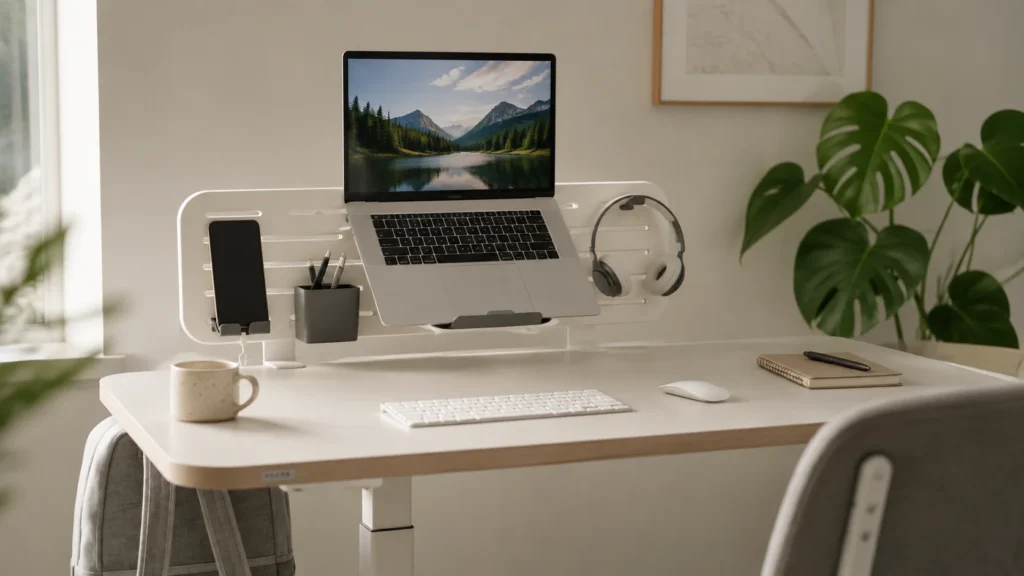
The most convincing part of the Leitz Ergo design is that it does not ask you to hide everything. Traditional desk organisation often means putting things into drawers, trays and boxes, which looks wonderfully tidy until you forget what is inside them. Vertical open storage keeps useful objects visible while moving them out of the immediate working zone.
The included accessories also provide enough structure to get started without requiring you to design an entire storage system. There is somewhere sensible for pens, somewhere for a notepad and a hook for headphones. That covers several of the objects most likely to end up floating around a computer desk, while the wide pegboard slots allow the layout to be moved around.
What I would avoid is turning the board itself into another organisation project. It is very easy to start with the sensible goal of keeping three things off the desk and end up searching for additional accessories, redesigning layouts and trying to create the perfect pegboard. The useful version is much more boring: decide where a few important items live, then stop thinking about it.
That simplicity is what gives it a genuine place in an ADHD-friendly workspace. The board is not doing anything clever. It simply makes returning an object to the same visible location easier, which can be far more sustainable than relying on yourself to consciously tidy and reorganise the desk throughout the day.
Friction Points to Consider
- The clamp requires a compatible desk edge and suitable desktop thickness
- Visible organisation can still become visually busy if too many items are added
- The included storage accessories may not cover every item you want to organise
- People who prefer completely clear surfaces may still find the pegboard visually distracting
- A simple drawer organiser or headphone hook may solve the same problem for less money
Practical Reality Check
The question to ask before buying is what currently ends up scattered across your desk. If the answer is consistently the same handful of objects, then giving those things fixed vertical homes is a sensible solution. You already know what problem the organiser is being bought to solve.
If the answer is that absolutely everything ends up on the desk, a pegboard alone probably will not fix the underlying pattern. Moving clutter from the desktop onto a vertical board is still clutter if there is no limit to what gets added. In that situation, it may be more useful to decide what deserves to remain visible before buying more storage.
Being able to move the holders is helpful when you first install the board, particularly if you are unsure where the headphones or notepad will be easiest to reach. Once the layout feels right, though, leaving it alone is probably more useful than continually improving it. The point is to make those everyday objects easier to put away, not to create another desk project that is never quite finished.
Buying Guide
Check your desk before anything else. The small Leitz Ergo Pegboard is designed to clamp onto compatible desktops up to 35 mm thick, so desk construction and edge shape matter. It is better to confirm that first than discover after buying that an unusual frame or thick desktop prevents the clamp sitting correctly.
Then decide what you intend to store. The small model includes a notepad holder, pen holder and hanging hook, which is a useful combination for basic desk organisation. If you want to mount a laptop or create significantly more storage, Leitz also sells a larger pegboard configuration with additional accessories, so buying the larger system simply because it exists is unnecessary unless those extra functions solve a real problem.
Finally, think about where the board will sit within your field of view. If visual clutter is already one of the things you are trying to reduce, mounting it slightly to the side may work better than filling the area immediately behind your monitor. The goal is quick access without turning every stored object into something your eyes keep returning to.
Frequently Asked Questions
Is the Leitz Ergo Pegboard useful for ADHD?
It may be useful if you benefit from keeping important objects visible but find that leaving everything directly on the desk becomes distracting. Its main value is giving frequently used items consistent, visible locations.
What accessories come with the small Leitz Ergo Pegboard?
The small model includes a notepad holder, a pen holder and a hanging hook that can be used for headphones or another suitable accessory.
Do you need to drill into the desk?
No. The organiser uses a clamp-based mounting system, so installation does not require drilling holes into a compatible desktop.
Can the pegboard accessories be moved?
Yes. The accessories can be repositioned across the pegboard, allowing you to arrange frequently used items around the way you naturally work.
Will a pegboard automatically make my desk less cluttered?
Not necessarily. It works best when a small number of regularly used objects are given fixed positions. Filling the pegboard with miscellaneous items can simply move the clutter from one surface to another.
Alternatives to Consider
If only one object is causing problems, a more focused solution may be enough. A simple headphone hook, pen pot or document holder can solve a specific storage issue without adding an entire pegboard, which makes sense when the rest of the desk already feels organised.
A drawer organiser is another option if you prefer objects to disappear completely when they are not being used. That creates a visually calmer surface, although it works best when you reliably remember what is stored inside. If hidden storage tends to become forgotten storage for you, the visible nature of a pegboard may be more practical.
For a closer comparison of workspace products, Best ADHD Desk Setup Tools for Focus and Productivity (UK Guide) looks at lighting, keyboard comfort, mouse control, noise and desk organisation together. The wider ADHD Productivity Tools UK Guide then shows how physical and digital tools can fit into a broader setup. The right next step is the one that addresses what already bothers you, rather than simply giving you more equipment or storage to manage.
Final Verdict
This Leitz Ergo Pegboard Desk Organiser Review for ADHD Workspaces comes down to whether visible-but-contained storage suits the way your brain keeps track of things. If drawers make useful items disappear from memory but leaving everything across the desktop becomes distracting, vertical storage offers a practical compromise.
The included pen holder, notepad holder and hanging hook give common desk items clear homes while freeing up working space, and the adjustable layout means you can position them around your own habits. It will not magically create an organised workspace, and overfilling it would defeat much of the point. Used deliberately, though, it is the kind of simple physical system that can make keeping a desk functional require a little less thought.
Build a Simple ADHD Productivity System
If you want to bring everything together into one clear setup, this guide shows how tools, apps, and routines can work as one system.