
Quick Overview
- Smartwatches provide immediate, hard-to-miss reminders
- Vibration alerts reduce reliance on phone checking
- They support structured routines throughout the day
- Work best when combined with other ADHD tools
- Consistency matters more than complexity
Introduction
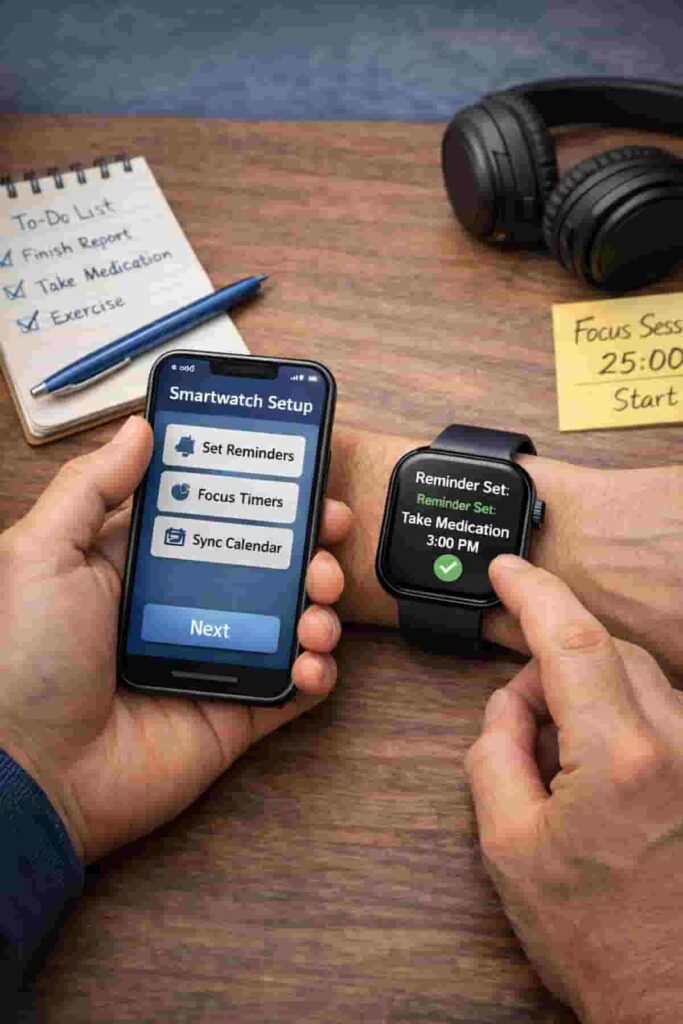
Learning how to use a smartwatch for ADHD time management and reminders (UK guide) can make a noticeable difference in how you handle daily tasks, especially if traditional phone notifications are easy to ignore. Many people find that wrist-based reminders feel more immediate and harder to dismiss compared to phones.
If you’re exploring device options, you can start with this guide on best smart watches for ADHD task reminders, which breaks down suitable devices for UK users.
For many people, smartwatch reminders for ADHD work best when they are part of a simple, repeatable daily system rather than a complex setup.
This article focuses on building a full system — not just using a smartwatch alone, but combining it with routines, environments, and supporting tools to create something that actually works day-to-day.
If you want to see how this fits into a wider setup, you can explore the Digital Productivity Tools for ADHD (UK Guide), which breaks down how everything works together.
Why ADHD Productivity Systems Matter
ADHD often isn’t about a lack of intention — it’s about inconsistency in attention, memory, and follow-through. You might set reminders, but miss them. Or plan your day, but lose track halfway through.
Smartwatches help reduce one key issue: “out of sight, out of mind.” When something buzzes on your wrist, it’s harder to ignore than a silent phone sitting across the room.
Research suggests that external reminders can help reduce the impact of executive function challenges in ADHD, particularly around time management and task initiation (source: NHS).
Personally, I’ve found that I can ignore phone notifications almost automatically, but a vibration on my wrist interrupts my attention just enough to bring me back to what I was meant to be doing.
The Core Components of an ADHD Productivity System
- Focus tools
- Reminder systems
- Environment control
- Routine structure
How Different Tools Work Together
Using a smartwatch on its own can help, but it becomes far more effective when layered with other tools.
For example:
– A smartwatch delivers reminders
– A focus app blocks distractions
– A structured routine defines when tasks happen
– Your environment reduces interruptions
This layered approach removes the need to rely on memory or motivation alone.
If you’re comparing devices, it’s worth looking at options like the Apple Watch Series 9 for ADHD task reminders or the Samsung Galaxy Watch 6 for ADHD task reminders, as different ecosystems suit different setups.
Example ADHD Productivity Setup
Morning Setup
Start with 2–3 simple reminders:
– Wake up
– Start work or first task
– Transition out of morning routine
Keep this simple — too many alerts early on can feel overwhelming.
Work Blocks
Use timed reminders to structure your work:
– Start task
– Midpoint check-in
– End of block
This helps reduce time blindness, which is a common ADHD challenge.
Break Management
Breaks are often where focus is lost. A smartwatch can:
– Signal when a break starts
– Signal when it ends
– Prompt you to return to work
End of Day Reset
Use a final reminder to:
– Review unfinished tasks
– Prepare for the next day
– Mentally “close” the workday
Common Mistakes to Avoid
- Setting too many reminders at once
- Ignoring vibration intensity settings
- Not linking reminders to a routine
- Relying on the smartwatch alone
- Changing systems too frequently
Building a Simple System That You Are Able To Stick To
The most effective approach is not the most complex one — it’s the one you’ll actually use consistently.
Start small:
– 3–5 daily reminders
– Fixed times each day
– Clear purpose for each alert
Then build gradually.
Devices like the Fitbit Versa 4 for ADHD task reminders or Amazfit Bip 5 for ADHD task reminders can be useful if you want something simpler and less overwhelming.
I’ve personally found that when I try to optimise everything at once, I stop using the system entirely. Keeping it minimal at the start tends to work better.
Frequently Asked Questions
Do smartwatches really help with ADHD time management?
They can help by making reminders more noticeable and consistent, especially when paired with routines.
Are smartwatches better than phone reminders?
For many people, yes — because wrist notifications are harder to ignore and don’t require you to check your phone.
How many reminders should I set?
Most people with ADHD benefit from starting with 3–5 reminders per day. This keeps the system simple and prevents overwhelm, while still providing enough structure to stay on track.
Do I need an expensive smartwatch?
Not necessarily. Simpler models can be just as effective if they deliver reliable notifications.
Final Thoughts
Understanding how to use a smartwatch for ADHD time management and reminders (UK guide) is less about the device itself and more about how it fits into your daily system.
When combined with routines, focus tools, and a controlled environment, a smartwatch becomes a reliable anchor throughout the day — helping you stay on track without constantly relying on willpower.
Keep it simple, build gradually, and focus on consistency over perfection.
Build a Simple ADHD Productivity System
If you want to bring everything together into one clear setup, this guide shows how tools, apps, and routines can work as one system.